
The Quiet Revolution: How AI-Designed Cells Are Rewriting the Future of Solar Panels in Milton Keynes & Beyond

Updated: Jan 13
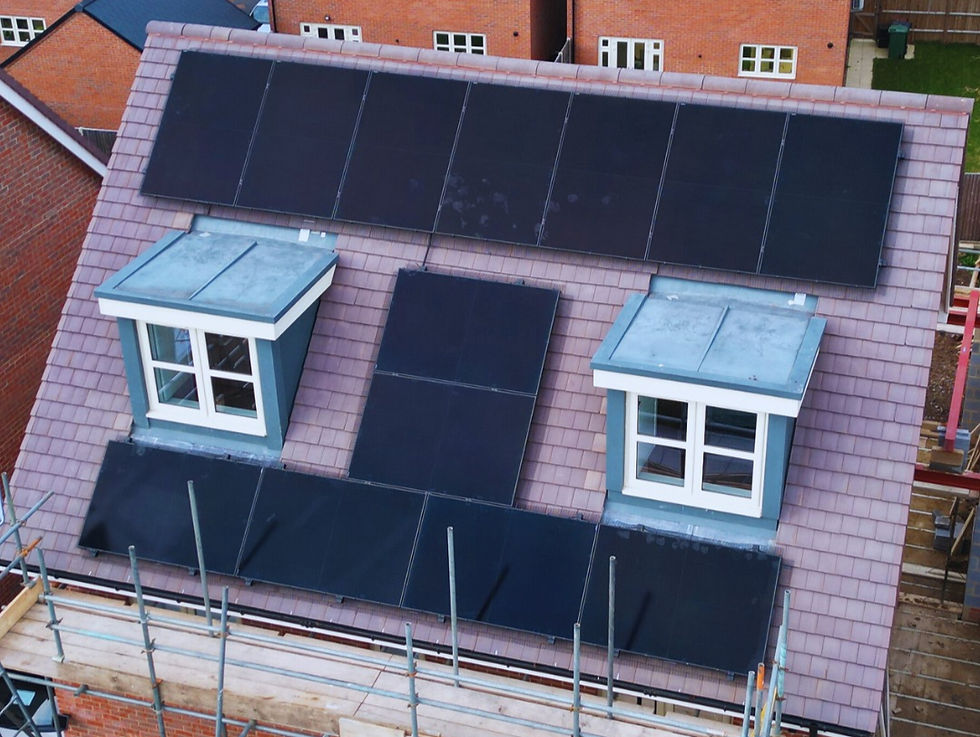
The solar industry has never been short of innovation, but 2025 has delivered something fundamentally different — a shift driven not by new materials or manufacturing techniques, but by artificial intelligence itself. For the first time, commercially viable solar cells designed with the help of advanced AI modelling are entering production, promising higher efficiency, lower degradation, and more adaptable performance across real-world conditions.
It’s a revolution that didn’t arrive with fireworks, but through years of quiet research. And now, as global energy systems strain under rising demand and fluctuating prices, AI-optimised solar cells are set to become one of the most transformative technologies in the energy landscape.
This is where machine learning meets sunlight — and the results could change how every home powers its life.

The Breakthrough: Solar Cells Designed by Algorithms, Not Guesswork
Traditional solar development has long relied on physical experimentation — adjusting materials, doping levels, and cell geometries, then testing each variant. It’s a process measured in months and years. But this year, major labs and manufacturers began deploying AI-guided optimisation engines that can simulate thousands of designs in minutes.
The result? Solar cells shaped not by human intuition, but by data.
These next-generation cells promise:
Higher conversion efficiency through micro-optimised junction geometry
Reduced light-induced degradation (LID) thanks to improved N-Type modelling
Adaptive performance under low-light and angled conditions
More stable behaviour across temperature swings
Companies across Europe and Asia have already begun early production runs. What once required years of prototyping is now compressed into weeks. For the first time, solar cell design is being refined at algorithmic speed.
And it’s not just the tech giants — even mid-sized manufacturers can now license AI-driven modelling platforms, opening the door to widespread adoption.
Why It Matters: Real-World Performance, Not Just Lab Numbers
Solar technology has always advertised peak efficiency under controlled conditions. But homeowners don’t live in labs — they live under cloudy skies, awkward roof pitches, seasonal haze, and imperfect angles.
AI-designed cells tackle this head-on.
By training models on real-world irradiance data, historical climate patterns, and millions of performance-simulation cycles, AI can design panels that:
Produce more morning and evening power
Maintain stronger output during winter months
Reduce drop-off during partial shading
Deliver more stable energy curves, easing battery management
This is energy designed for life as it’s actually lived.
And for homeowners, it means a future where solar arrays generate meaningfully more power without increasing system size.
A New Kind of Efficiency Race
For years, solar efficiency crept upward slowly — tenths of a percent at a time. AI is accelerating that pace. Early tests from several research groups suggest efficiency gains of 2–4% above comparable conventional cells, achieved through micro-scale geometry adjustments that humans would never think to try.
One manufacturer described the process as “searching for the solar equivalent of aerodynamic sweet spots.”
Instead of broad category improvements, AI targets thousands of tiny refinements:
Junction tapering
Anti-reflective layering patterns
Electron pathway routing
Surface texturing at nanoscale
Each adjustment might contribute 0.01% — but with AI exploring millions of combinations, the accumulated gains are significant.
This isn’t just evolution; it’s guided acceleration.
Machine Learning Meets Manufacturing: From Model to Module
One of the most remarkable aspects of this shift is that AI doesn’t stop at the cell design; it also optimises the manufacturing process.
Model-based predictions can guide:
Ideal temperatures for thermal processing
Chemical deposition levels
Timing for passivation layers
Cell spacing to minimise thermal stress
By predicting failure points before they occur, AI systems reduce waste, improve lifespan, and increase consistency.
It’s an entire pipeline of intelligence — from the first simulation to the final installed panel.
Impact on Homeowners: What This Means for the Next Generation of Solar Installations
For households considering solar, AI-designed panels offer several tangible benefits:
More Power in the Same Roof Space
Higher efficiency means more usable energy without adding more panels — especially valuable on smaller or complex roofs.
Better Year-Round Generation
AI models optimise for seasonal variation, giving homeowners stronger winter and low-light performance.
Improved Compatibility With Batteries
Stable output curves reduce cycling stress on storage systems like the Sigenergy SigenStor, enhancing long-term battery health.
Longer Lifespan and Slower Degradation
AI-guided N-Type optimisation means the system performs consistently for more years.
More Predictable Bills and Energy Independence
With stronger low-light generation and better winter curves, homeowners experience smoother, more reliable renewable supply.
This turns solar from a “summer asset” into a year-round backbone.
What Installers Are Saying: Faster Design, Fewer Unknowns
Installers, particularly in Europe and the UK, are welcoming the shift for practical reasons. AI-modelled panel behaviour leads to:
More accurate system predictions
Improved alignment with dynamic tariffs
Reduced shading risk modelling errors
Better forecasting for energy storage sizing
As a result, installers can design more efficient systems with greater confidence — especially for complex properties with split rooflines, multiple angles, or limited mounting areas.
In short, AI makes solar planning less of an art and more of a precision science.
The Grid-Level Impact: A More Flexible Energy Future
Zooming out, the rise of AI-designed solar cells has implications far beyond individual homes.
As adoption grows, the grid benefits from:
More stable distributed generation
Reduced strain on peak-hour supply
Greater renewable penetration without major infrastructure upgrades
Improved predictability for grid operators
This shift helps national grids support higher renewable percentages without sacrificing reliability.
In other words: smart cells create a smarter grid.
Challenges Ahead: Not Everything Is Solved Yet
Despite the excitement, several challenges remain:
Manufacturing capacity needs time to scale
Licensing costs for advanced modelling engines are still high
Supply chain bottlenecks could delay widespread rollout
Standards and certification must be updated for AI-designed components
But the trajectory is clear: the technology is moving from research labs into commercial production at a pace few expected three years ago.
A Turning Point for the Solar Industry
In hindsight, this leap was inevitable.
The complexity of solar cell optimisation — with thousands of interacting variables — is exactly the kind of challenge AI excels at. And now that manufacturers have begun adopting these tools, the competitive landscape is shifting rapidly.
What once seemed like gradual progress has become a race powered by algorithms, data, and cloud-scale simulation.
The next decade of solar won’t be defined by what humans can design, but by what machines can discover.
The Future Shines Brighter Than Ever
The arrival of AI-designed solar panels in Milton Keynes and beyond marks a profound moment in the energy transition. It represents a new philosophy: that renewable technology should learn, adapt, and improve continuously.
For homeowners, it means better performance, lower costs, and more energy autonomy. For installers, it means smarter builds and more predictable outcomes. And for the world, it marks another step toward a cleaner, more flexible energy future.
The revolution didn’t come loudly — but it came decisively.
The future of solar has just been redesigned.
Speak to our friendly and knowledgeable installers at Now EV today to get started!


Comments